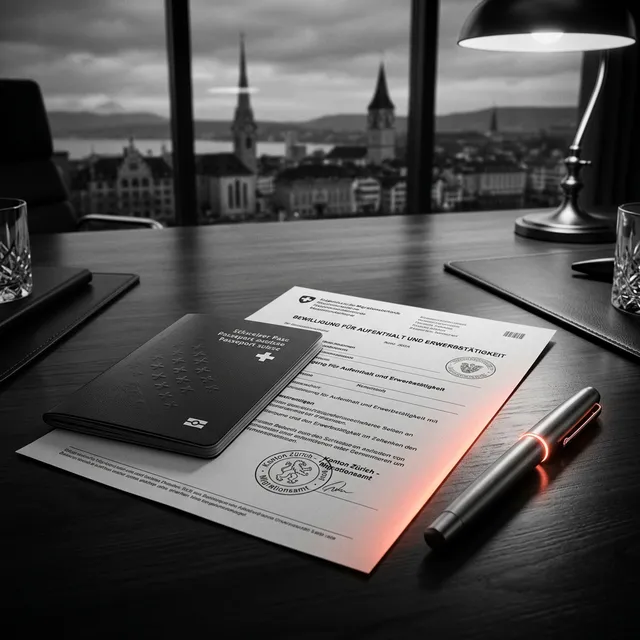
Understanding Switzerland’s work permit system is the single most important step in any relocation to Switzerland. Whether you are an EU citizen taking advantage of free movement agreements or a non-EU national navigating the quota system, the permit you hold determines where you can live, how long you can stay, and what rights you have. Getting it wrong — or simply being slow — can delay your entire move by months.
This guide covers every permit type relevant to working in Switzerland in 2026, with a detailed focus on the B-permit, the most common residence permit for employed foreigners.
Overview of the Swiss Permit System
Switzerland operates a dual-track immigration system: one set of rules for EU/EFTA nationals (benefiting from the bilateral Agreement on Free Movement of Persons) and a more restrictive system for all other nationalities (so-called third-country nationals).
All permits are administered at the cantonal level by the respective cantonal migration office, though federal authorities (the State Secretariat for Migration, or SEM) set quotas and approve certain permit categories.
Permit Types at a Glance
| Permit | Full Name | Who It’s For | Duration | Path to C-Permit |
|---|---|---|---|---|
| L | Short-term residence | Workers with contracts under 12 months | Up to 12 months | No direct path; must convert to B first |
| B | Residence permit | Workers with contracts of 12+ months | 5 years (EU/EFTA) or 1 year renewable (non-EU) | After 5 years (EU/EFTA) or 10 years (non-EU) of continuous residence |
| C | Permanent residence (settlement) | Long-term residents meeting integration criteria | Unlimited | Already the permanent permit |
| G | Cross-border commuter | Frontaliers living in EU, working in Switzerland | 5 years (if permanent employment in EU) | No; requires Swiss residence for C-path |
| S | Temporary protection | Persons needing temporary refuge | 1 year, renewable | Possible after 5+ years, case-dependent |
For the vast majority of professional relocations, the B-permit and L-permit are the relevant categories.
EU/EFTA Nationals: The Simplified Process
Citizens of EU and EFTA member states benefit from substantially easier access to Swiss work permits under the Agreement on the Free Movement of Persons (AFMP).
Key Rules for EU/EFTA Workers
- No labor market test required. Employers do not need to prove that no Swiss candidate is available.
- No quota restrictions. EU/EFTA nationals are not subject to annual permit quotas.
- B-permit validity: 5 years, automatically renewable if employment continues.
- Right to change employers and cantons without a new permit application (though notification is required).
- Family reunification is automatic for spouses and children under 21.
The 90-Day Rule
EU/EFTA nationals can work in Switzerland for up to 90 working days per calendar year without a formal residence permit, subject to an online notification (Meldeverfahren). This is commonly used for short-term project assignments, consulting engagements, and business travel that involves active work.
Important: The 90-day rule applies per person per calendar year across all Swiss engagements, not per employer. Industries with specific regulations (e.g., construction, cleaning, security) may have stricter notification requirements.
Registration Process for EU/EFTA Nationals
For stays exceeding 90 days:
- Employer issues employment contract or letter of intent with contract terms
- Employee enters Switzerland (no visa required for EU/EFTA citizens)
- Registration at the commune (Einwohnerkontrolle / Controle des habitants) within 14 days of arrival
- Cantonal migration office issues the B-permit based on the employment contract (typically 2 — 4 weeks)
- Biometric residence card (credit-card format) is mailed within 4 — 8 weeks
The process is largely administrative. Rejections of EU/EFTA B-permit applications are extremely rare and typically involve only cases of serious criminal records or public security concerns.
Non-EU Nationals: Labor Market Test and Quota System
For citizens of countries outside the EU/EFTA, obtaining a Swiss work permit is significantly more complex and competitive.
The Two-Tier Requirement
Non-EU nationals must clear two hurdles:
- Labor market test (Inländervorrang): The employer must demonstrate that no suitable Swiss or EU/EFTA candidate could fill the position. This involves documenting the recruitment process and explaining why the specific non-EU candidate is essential.
- Quota allocation: Non-EU work permits are subject to annual federal quotas, allocated to cantons. Once a canton exhausts its quota for the year, no further permits can be issued until the next allocation.
2026 Quota Numbers
The Swiss Federal Council sets annual quotas. For 2026, the allocation is:
| Permit Type | Annual Quota (Non-EU) |
|---|---|
| B-permits (residence, 12+ months) | ~4,000 |
| L-permits (short-term, under 12 months) | ~8,500 |
These quotas are shared across all 26 cantons, with larger cantons (Zurich, Geneva, Vaud) receiving larger allocations. Quotas often run out in popular cantons by Q3 or Q4, making early application critical.
Qualifying Criteria for Non-EU Nationals
Beyond the quota, the employer must demonstrate:
- The position requires a qualified professional (typically requiring a university degree or equivalent professional qualification)
- The offered salary meets local market rates (Orts- und Branchenüblichkeit) — undercutting Swiss salary levels is grounds for rejection
- The company has made genuine recruitment efforts within Switzerland and the EU before turning to a non-EU candidate
- The hire serves the economic interest of Switzerland (Gesamtinteresse der Wirtschaft)
Certain categories receive preferential treatment: senior executives, specialists with rare expertise, researchers, and intra-company transferees from multinational firms with Swiss operations.
B-Permit Deep Dive: Step-by-Step Application
The B-permit is the workhorse of Swiss immigration for employed professionals. Here is the complete application process.
Step-by-Step Process
| Step | Timeframe | Documents Needed |
|---|---|---|
| 1. Employer prepares application | Week 1 | Employment contract, job description, company registration, recruitment documentation (non-EU) |
| 2. Submission to cantonal migration office | Week 1 — 2 | Completed application forms, passport copies, CV, degree certificates, passport photos |
| 3. Cantonal review and pre-approval | Weeks 2 — 6 (EU) / Weeks 2 — 10 (non-EU) | Canton may request additional documentation |
| 4. Federal approval (non-EU only) | Weeks 6 — 12 | SEM reviews quota availability and application quality |
| 5. Permit authorization issued | Weeks 4 — 8 (EU) / Weeks 8 — 16 (non-EU) | Authorization letter sent to employer and Swiss embassy (if applicable) |
| 6. Visa issuance (non-EU, if required) | Weeks 1 — 3 after authorization | Employee visits Swiss embassy in home country with authorization |
| 7. Entry to Switzerland and commune registration | Within 14 days of arrival | Passport, permit authorization, rental agreement, health insurance proof |
| 8. Biometric card production | 4 — 8 weeks after registration | Automatically mailed to registered address |
Employer Responsibilities
The employer is the primary applicant for all Swiss work permits. This means:
- The employer submits the application and bears the administrative burden
- The employer is responsible for ensuring the employee’s qualifications match the position
- If the employee leaves the company, the permit does not automatically transfer — a new application may be required (non-EU nationals)
- The employer must notify the cantonal authorities of any significant changes (salary, role, termination)
Family Reunification Under the B-Permit
B-permit holders can bring their spouse (or registered partner) and children under 18 to Switzerland. The family members receive their own B-permits linked to the primary holder.
Requirements for family reunification:
- Proof of adequate housing (Swiss authorities enforce minimum living space standards)
- Proof of sufficient financial means to support the family without social assistance
- For non-EU nationals: family reunification should ideally be applied for simultaneously with the primary permit or within 12 months of the primary holder’s arrival
Spouses of B-permit holders have the right to work in Switzerland without an independent work permit, regardless of their own nationality. This is an important benefit that many relocating families overlook. For families with children, securing international school placement should happen in parallel with the permit process.
Ready to compare agencies?
Need help with your Swiss work permit? Compare agencies offering immigration and visa support.
Compare Verified Agencies →Digital Immigration: ePermit System Updates in 2026
Switzerland has been progressively digitizing its immigration processes. Key developments in 2026:
- Online application submission is now available in most cantons for EU/EFTA permit applications, reducing processing times by an estimated 1 — 2 weeks
- Digital status tracking allows employers and employees to monitor application progress through cantonal portals
- Electronic residence cards with biometric data remain the standard physical document, but digital verification is increasingly accepted for employer compliance checks
- Automated notifications alert applicants at each processing milestone
However, the system remains fragmented across cantons. Zurich, Geneva, and Basel-Stadt have the most advanced digital platforms, while smaller cantons may still require paper submissions for certain permit types.
Common Mistakes That Delay Permits
Based on immigration specialist feedback, these are the most frequent errors that cause processing delays:
- Incomplete documentation. Missing a single required document can add 2 — 4 weeks while the migration office requests it. Prepare everything upfront.
- Salary below market rate. For non-EU applications, offering a salary below the local industry benchmark is one of the most common reasons for rejection or additional scrutiny.
- Weak labor market test documentation. Simply posting a job ad on one platform is insufficient. Cantonal offices expect evidence of genuine, multi-channel recruitment efforts.
- Late application timing. Submitting a non-EU permit application in Q4 risks encountering exhausted cantonal quotas. Apply as early in the year as possible.
- Incorrect canton of application. The application must be submitted in the canton where the employee will work, not where the company is headquartered (if different).
- Missing apostilles or certified translations. Foreign documents (degrees, marriage certificates, criminal background checks) often require apostille certification and certified translation into the local official language.
- Not declaring all family members. Failing to include family members in the initial application can complicate subsequent family reunification.
Switching Permits: L to B, B to C
Understanding the upgrade paths between permits is essential for long-term planning.
L-Permit to B-Permit
If your initial contract was under 12 months (L-permit) and your employer extends it or offers a permanent position:
- EU/EFTA nationals: Straightforward conversion. Submit the new contract to the cantonal migration office. The B-permit replaces the L-permit with no quota implications.
- Non-EU nationals: Conversion may require a new quota allocation, depending on cantonal policy and timing. Some cantons treat this as a new application.
B-Permit to C-Permit (Permanent Residence)
The C-permit is the gold standard — it offers permanent residence, full labor market access, and significantly easier administrative life.
Eligibility requirements:
- EU/EFTA nationals: 5 years of continuous, lawful residence in Switzerland with a B-permit (reduced to 5 years from the previous 10 under certain bilateral agreements)
- Non-EU nationals: Generally 10 years of continuous residence (reduced to 5 years for nationals of the USA, Canada, UK, and certain other countries with bilateral agreements)
- Integration criteria: Adequate language skills (typically A2 — B1 level in the local official language), knowledge of Swiss society, no criminal record, financial independence
Important Note on Continuous Residence
Absences from Switzerland exceeding 6 consecutive months or totaling more than 10 months within a year can interrupt the continuous residence calculation. Business travelers and employees with frequent international assignments should track their Swiss presence carefully.
Canton-Specific Processing Times
Processing times vary significantly across cantons due to staffing levels, application volumes, and administrative efficiency.
| Canton | EU/EFTA B-Permit | Non-EU B-Permit | Notes |
|---|---|---|---|
| Zurich | 4 — 6 weeks | 10 — 16 weeks | Highest volume; digital portal available |
| Geneva | 4 — 8 weeks | 10 — 14 weeks | French-language process; OCPM handles all permits |
| Vaud | 4 — 6 weeks | 8 — 14 weeks | Growing tech sector driving increased applications |
| Basel-Stadt | 3 — 5 weeks | 8 — 12 weeks | Efficient processing; pharma industry experience |
| Zug | 3 — 4 weeks | 8 — 12 weeks | Lower volume; generally fast processing |
| Bern | 4 — 6 weeks | 10 — 14 weeks | Federal capital; bilingual (DE/FR) processing |
| Schwyz | 3 — 5 weeks | 8 — 12 weeks | Lower volume; efficient for straightforward cases |
| Ticino | 4 — 6 weeks | 10 — 14 weeks | Italian-language process; cross-border complexity |
These are estimates based on standard applications with complete documentation. Complex cases (non-EU nationals with unusual qualifications, intra-company transfers, or family reunification) may take longer. For city-specific relocation details, see our guides for Zurich, Geneva, Basel, and Bern.
When to Hire an Immigration Specialist
While straightforward EU/EFTA permit applications can often be managed by an experienced HR department, professional immigration support is strongly recommended in these situations:
- Non-EU national applications where the labor market test and quota system apply
- Senior executive or specialist permits requiring detailed economic interest justifications
- Complex family situations (blended families, non-married partners, dependent adult children)
- Permit conversions (L to B, B to C) with potential complications
- Cross-border arrangements (G-permit combined with partial Swiss residence)
- Any situation involving previous permit refusals or immigration history issues
For employers managing multiple transfers, our Corporate Relocation guide covers the full process from HR’s perspective. A qualified Swiss immigration specialist can reduce processing times, avoid costly mistakes, and significantly increase approval rates for non-EU applications.
Find Your Relocation Expert
Compare verified Swiss relocation agencies. See real reviews, transparent pricing, and get matched in 24 hours.
Browse All Agencies →